Okasha
Sammer
One-Man Army vs. Agency: Why Smart Home Service Businesses Are Choosing Solo Experts
Jump To
This is not a post about why agencies are bad. Some agencies do excellent work — I will say so clearly later in this post. But I have spent six years watching home service businesses make the same expensive mistake: hiring a multi-person agency when what they actually needed was one person who could see the whole picture.
The result is always the same. Multiple account managers. Siloed deliverables. Nobody responsible for the full outcome. And a business owner who is somehow more confused about their own marketing after six months of agency reports than they were before they signed the contract.
This post lays out the honest comparison. When an agency is the right call. When a solo expert makes more sense. And how to tell the difference before you spend money finding out the hard way.
Should I Hire a Marketing Agency or a Freelancer for My Home Service Business?
For most home service businesses generating under $500k/year, a solo expert — one person who works across SEO, copy, ads, and brand with a single unified strategy — delivers better results per dollar than a multi-person agency.
Agencies make more sense when your business is scaling fast, has budget to invest in a full-service team, and already has the foundation (converting pages, clear offer, brand trust) in place.
The honest answer depends on three things: where you are in your growth, what you actually need fixed, and how much coordination overhead you can afford to absorb.
Most small and mid-size home service businesses underestimate the coordination overhead of an agency. Every specialist needs briefing. Every deliverable needs review. Every report needs interpreting. You hired the agency to reduce your workload — but managing the agency often becomes a second job.
What You Actually Get From Each
| ❌ Multi-Person Agency | ✅ Solo Expert |
|---|---|
| Separate specialists | One expert, one strategy |
| Channel-focused optimisation | Full-funnel optimisation |
| Siloed reporting | Revenue-focused reporting |
| Rankings & clicks | Booked jobs & conversions |
| 3–5 people involved | One direct point of contact |
| Slower decisions | Faster implementation |
| More overhead | Lower overhead |
| $1,500–$5,000/month | $300–$800/project or $400–$750/month |
The Coordination Problem Nobody Talks About
Here is what an agency engagement looks like in practice for most home service businesses.
Month one: onboarding. Multiple calls. Questionnaires. Strategy documents. Nothing live yet. Month two: first deliverables — pages updated, an ad campaign launched, a content calendar proposed. Each produced by a different person who has not spoken to the others. Month three: first report. Rankings improved slightly. Impressions are up. Revenue is flat. Nobody on the agency side is sure why — because each specialist only sees their slice.
Month four: you ask why the landing pages the ads send traffic to have not been touched. The ads person says that is the web team’s job. The web team says they were not briefed on the ad campaign.
The structural problem
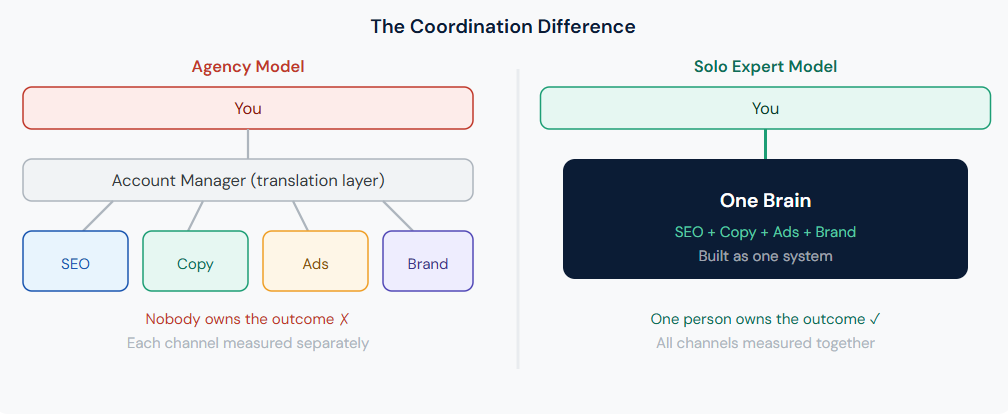
In a multi-person agency, nobody is responsible for the thing that actually matters how all the channels work together to produce a booked job. Each specialist is responsible for their metric. Nobody is responsible for the outcome. And when the outcome is flat, the agency points to channel metrics that look fine.
What a Solo Expert Actually Does Differently
When one person handles SEO, copy, ads, and brand not as four separate projects, but as one connected system the coordination problem disappears by default.

When an Agency IS the Right Call
The last point is the most important filter. An agency that leads with deliverables before understanding your conversion baseline is optimising for their process, not your outcome.
The Honest Trade offs

How to Choose: Four Questions to Answer First
The neckline creates a visual frame for the face, the neck and the earrings together. The earring length must work within that frame not extend past the neckline, not crowd the collar, and not add weight where the neckline already provides it.
Frequently Asked Questions
Should I hire a marketing agency or a freelancer for my home service business?
What are the advantages of hiring a solo marketing expert?
What are the disadvantages of hiring a solo expert?
When does hiring a marketing agency make sense?
How do I know if a solo expert is the right fit?
Recent Post





Quick Links:
Contact Details:
- Email: : me@okashasammer.com
- Phone: +92-3335232846