In less competitive markets, profile and citation fixes can move you into the top three within 30 to 90 days. Competitive markets take longer and lean on reviews and links built over time. A proper audit gives you a realistic timeline for your area.
You do excellent work, but the homeowner searching right now never sees you. They tap one of the three businesses in the map at the top of Google and book. If your Google Business Profile is weak or half-filled, that call goes to a competitor whose work is worse than yours. This checklist fixes that.
A Google Business Profile is the free listing that puts your business on Google Search and Google Maps. For a contractor, it is the single most valuable piece of real estate in local search, because it feeds the Map Pack: the block of three businesses shown with a map above the regular blue links.
The numbers explain why it matters so much. Around 46% of all Google searches have local intent, and the local 3-pack appears in the large majority of those searches. Nearly half of local search clicks go to map results rather than the organic links below, and most people who run a local search visit or contact a business within a day.
Most contractors claim their profile, add a phone number, and stop. That leaves half the listing empty and hands the ranking to whoever finished the job. Work through these in order.
Your primary category is the strongest single ranking signal on the profile, according to local ranking research from firms like Whitespark. Choose the most specific category that matches your core service. A roofer should select “Roofing contractor,” not the vaguer “Contractor.” Add secondary categories for your other services, but never dilute the primary.
Your business name, address, and phone number, known as your NAP, must be identical everywhere Google finds it. Do not stuff keywords into your business name; use your real name. Inconsistent details across directories quietly drag your ranking down and confuse Google about which business is real.
Add each service you offer as its own entry, and list the towns and neighborhoods you cover as service areas. This tells Google exactly what you do and where, which is the same job location pages in your on-page SEO handle on your website. The two reinforce each other.
Upload genuine before-and-after shots, job-site photos, and pictures of your team and trucks. Stock images do nothing. Real photos build trust with a cautious buyer and give Google fresh signals that the business is active. Add new ones every month.
Use Google Posts to share recent jobs, seasonal offers, and answers to common questions. A profile that posts looks active and gives Google more content to match against searches. Aim for one post a week, even a short one.
Field tip: Fill out every field Google offers, including hours, attributes, and the business description. A complete profile outranks a half-empty one in the same market, even before you touch reviews or links.
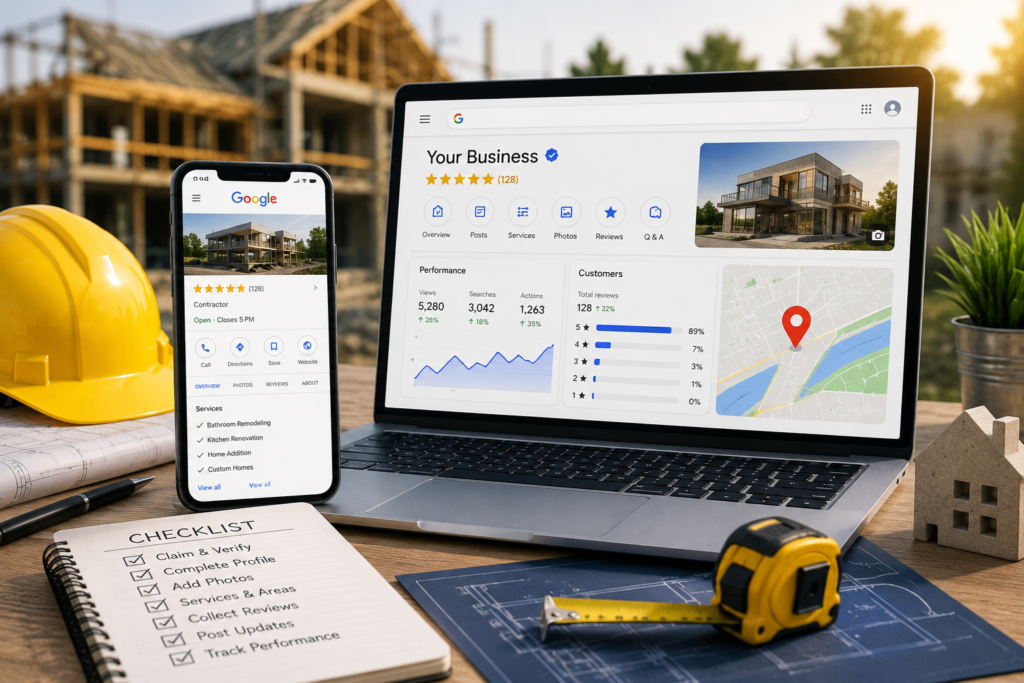
Reviews influence both where you rank and whether a buyer picks you. BrightLocal’s research shows the vast majority of consumers read online reviews for local businesses, and a strong share will not consider a business rated below three stars.
Three rules run a review system that actually moves rankings:
Ask every happy customer. Send a direct link to leave a Google review the day you finish the job, while the goodwill is fresh.
Keep them recent. A steady trickle of new reviews beats a pile of old ones. Recency is a signal.
Reply to all of them. Respond to every review, positive and negative. It shows Google and buyers that you are engaged.
Reviews are also the clearest example of why ranking is only half the battle. Getting seen means nothing if your profile and pages do not turn that visibility into booked calls.
| Mistake | Why it hurts |
|---|---|
| Keyword-stuffed business name | Violates Google guidelines and risks suspension |
| Wrong or vague primary category | Loses the strongest ranking signal you have |
| Inconsistent NAP across directories | Confuses Google and weakens prominence |
| No reviews or ignored reviews | Lowers ranking and trust at the same time |
| Empty services, photos, and posts | Signals an inactive, lower-priority listing |
A strong Google Business Profile is step one, not the whole plan. It works best when your website backs it up with location pages, and when your site turns the traffic into calls. That is the idea behind the full growth system I run for contractors: rank, convert, and retain as one connected machine instead of a stack of disconnected tactics.
If you want the tactical companion to this guide, read how to get more calls from Google Maps, which goes deeper on the calls side
In less competitive markets, profile and citation fixes can move you into the top three within 30 to 90 days. Competitive markets take longer and lean on reviews and links built over time. A proper audit gives you a realistic timeline for your area.
Your primary category carries the most weight, followed by proximity to the searcher and the strength of your reviews. Choosing the most specific category that matches your main service is the highest-impact single setting.A
There is no magic number. What matters is having more recent, higher-rated reviews than the competitors you want to outrank, and replying to all of them.
Yes. Run a service-area business that hides the street address and lists the towns you cover. It still ranks in the Map Pack across your service area.