Okasha
Sammer
Why the Roofing Contractor Who Ranks #4 Gets More Calls Than the One at #1
Jump To
A business finally hits position one for its main keyword. Traffic comes. The calls don’t increase nearly as much as expected. Meanwhile, a competitor sitting at position four, with a less optimised website and sometimes fewer reviews, is booking more jobs. This is not luck. It’s a predictable pattern, and it has almost nothing to do with ranking.
The short version: ranking gets you seen. Trust gets you called. Trust is built in about three seconds on the page, before a homeowner ever picks up the phone.
This post explains exactly what happens in those three seconds, why position on the page matters less than most people think, and what the contractor at #4 is doing that the one at #1 is not.
Why Does Ranking #1 on Google Not Guarantee More Calls?
Ranking #1 gets your business seen first, but it does not automatically make a homeowner trust you more than the businesses ranked below you. Once a homeowner is comparing two or three options, which happens almost every time, the decision shifts from “who is listed first” to “who do I feel safest calling.”
That decision is driven by trust signals on the website and listing, not by position alone.
Here is what actually happens when someone searches for a contractor. They do not click the first result and call immediately. In almost every case, they open two or three results in separate tabs or scroll through the map listings, comparing photos, reviews, and snippets. This comparison phase is where the call gets decided, and it has very little to do with which business Google decided to rank first.
The Comparison Homeowners Actually Make
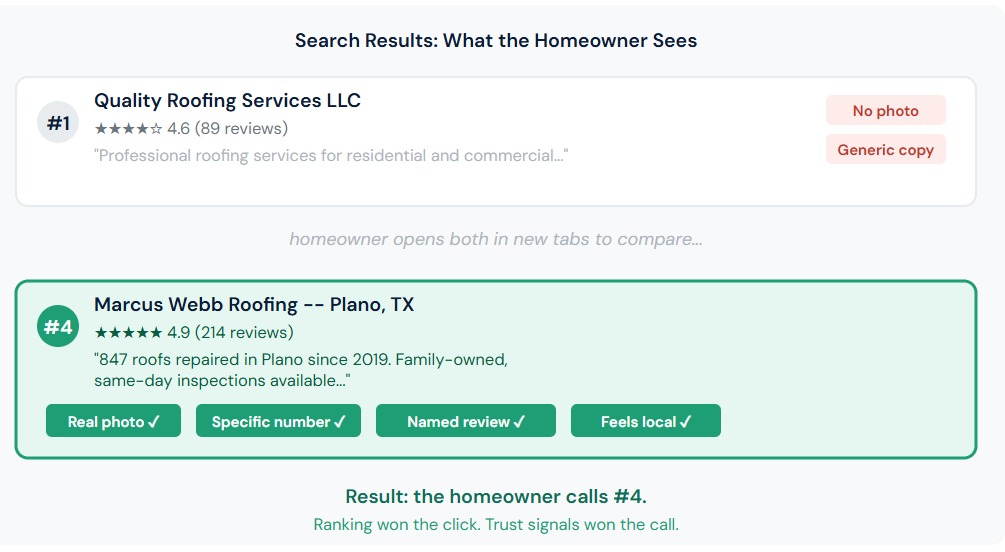
What #4 Has That #1 Does Not
In audits where I have seen this pattern play out, the business converting better from a lower position consistently has three things the higher-ranked competitor is missing.
1. A face
A real photo of the owner or the team — not a stock photo of a generic person in a hard hat. This single change does more for trust than almost anything else on a home service website. People do not hire companies. They hire people, and a company is just the wrapper.
Home services are high-trust purchases. Someone is letting a stranger into their home, on their roof, around their family. A face — a real one, ideally with a name — starts answering the unspoken question: “who exactly am I trusting with this?”
2. A story
Not a corporate “About Us” paragraph. A specific story that sounds like it could be about the person reading it. “I started this company after my own roof failed during a storm and I couldn’t find anyone who would show up the same day” tells a homeowner something a list of services never will.
The business at #1 often has an About page that reads like every other About page in the industry — founded in [year], serving the community, committed to quality. The business at #4 sometimes has one paragraph that sounds like an actual person, and that paragraph does more work than the entire rest of the site.
3. Proof that feels specific, not generic
“Trusted by thousands” is generic. “847 roofs repaired in Plano since 2019” is specific. “Great service, highly recommend” is generic. “Called Monday morning, had a tarp up within two hours, full replacement done by Thursday — Marcus W., Plano TX” is specific.
Specificity is the difference between a claim and proof. Claims can be made by anyone. Proof can only come from a real business that has actually done the work.
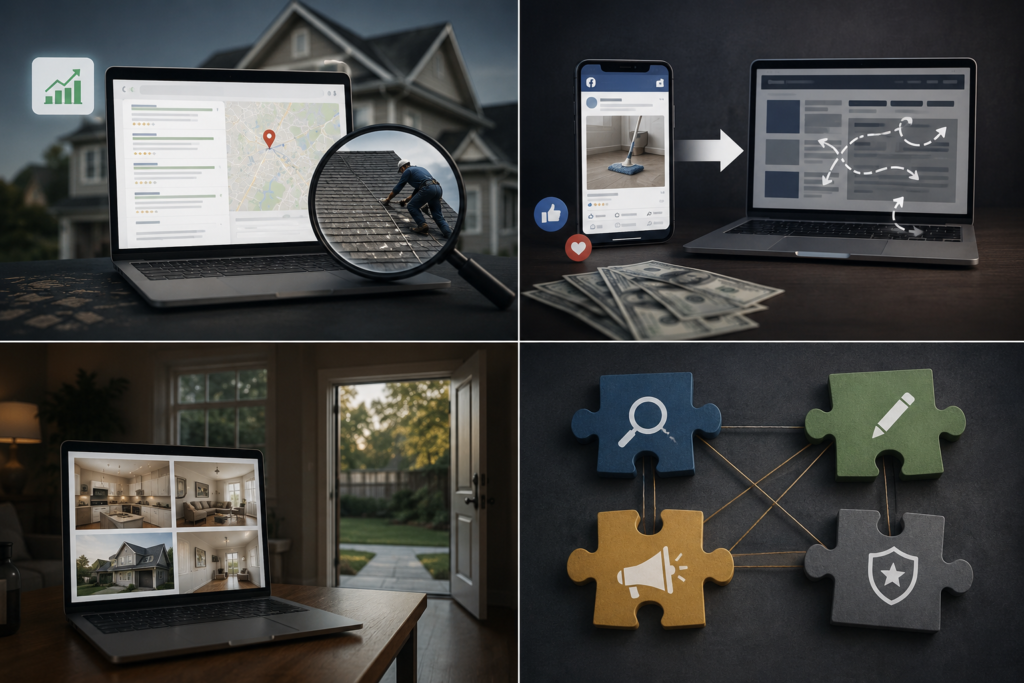
What a Connected System Looks Like in Practice
In a disconnected system, improving one pillar by 20% might improve overall results by 2-5%, because the other three pillars cap the impact. In a connected system, improving one pillar by 20% can improve overall results by 15-20%, because the gains flow through every other pillar. This is the entire difference between linear effort and compounding growth
The Diagnostic Framework: How to Find Your Weakest Link
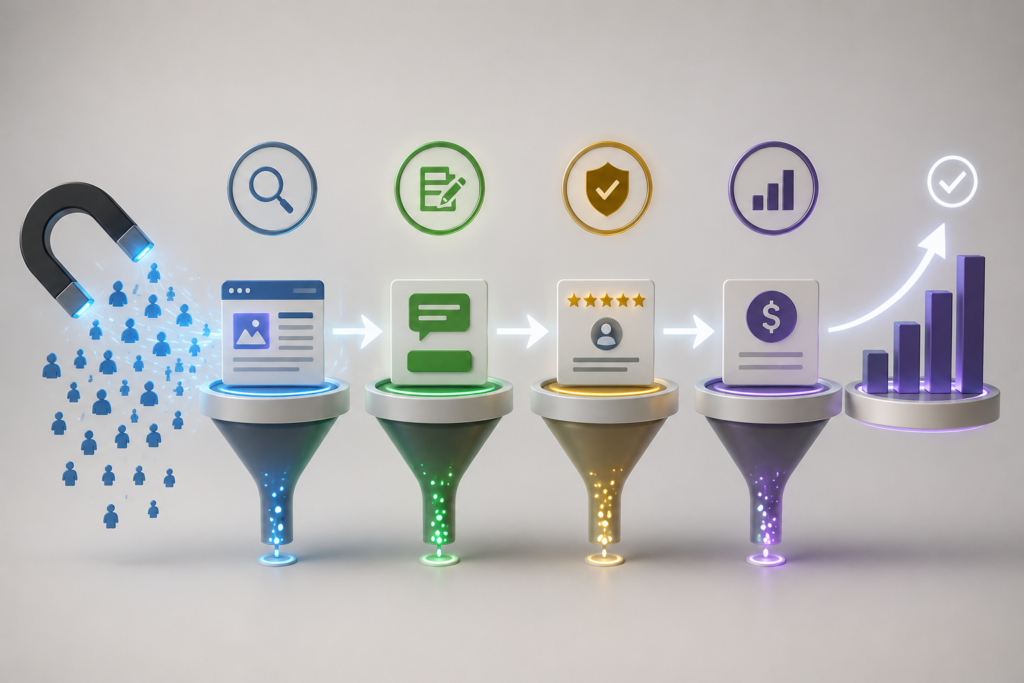
| Question | If the Answer Is Yes | Weakest Link |
|---|---|---|
| Are you getting traffic at all? | Your website gets very few visitors. | Visibility (SEO) or Demand Generation (Ads). Nothing else matters until people are arriving. |
| Of those arriving, how many take action? | Traffic exists, but conversion is very low (under 2–3%). | Conversion Copy. The page is not doing its job of turning visitors into leads. |
| Of those who engage, how many become customers? | Lead conversion is reasonable, but lead-to-customer conversion is low. | Brand Trust. You’re losing prospects during the comparison stage. |
| Is your cost to acquire a customer sustainable? | Customer acquisition costs are too high. | A combination of weak conversion and weak brand differentiation is keeping your cost per lead artificially high. |
What Is a Growth System for a Home Service Business?
A growth system for a home service business is the combination of SEO, conversion copy, paid advertising, and personal brand built and maintained as one connected structure rather than four separate services. Each pillar reinforces the others: SEO brings the right traffic to pages that convert, copy carries consistent brand trust, brand wins the comparison moment, and ads accelerate what is already proven to work.
What Should I Fix First in My Home Service Marketing?
Start with conversion copy on your single highest-traffic page — this has the fastest, most visible impact and is required groundwork for everything else. Then address brand trust elements site-wide. Then invest in SEO and AEO structure. Then use paid ads to accelerate the system you have built.
Fixing channels in any other order, especially starting with ads or SEO before conversion and brand are addressed, typically wastes the largest portion of marketing budget.
This Is Why I Built My Business This Way
Six years ago, I started as an SEO specialist. I got good at rankings. And I kept running into the same wall: clients ranking well, traffic increasing, revenue staying flat.
The problem was never the SEO. It was that SEO was the only thing anyone had built. The copy was generic. The brand was invisible. The ads pointed at pages that could not convert. Every channel was capped by the weakest one — and nobody was looking at the whole picture, because no single specialist is hired to look at the whole picture.
That is why I work across all four pillars — not because I wanted to do everything, but because I kept seeing the same businesses hit the same ceiling, for the same reason, regardless of how good any individual piece of their marketing was.

Frequently Asked Questions
What is a growth system for a home service business?
Why do home service businesses plateau despite doing everything right?
What should I fix first in my home service marketing?
Start with conversion copy on your single highest-traffic page. Then address brand trust elements site-wide. Then invest in SEO and AEO structure. Then use paid ads to accelerate the system you have built. Starting with ads or SEO before conversion and brand are addressed typically wastes the largest portion of marketing budget.
How long does it take to see results from a connected growth system?
Do I need to fix all four pillars at once?
Recent Post


Quick Links:
Contact Details:
- Email: : me@okashasammer.com
- Phone: +92-3335232846