Okasha
Sammer
How to Get More Calls from Google Maps in 2026
Jump To
Your phone should be ringing. You are listed on Google. You have reviews. You are in the area. But the calls are going to the competitor two streets away who opened eighteen months ago.
That is not a luck problem. That is a Google Business Profile problem.
This guide shows you exactly how to get more calls from Google Maps covering every signal Google uses to decide which home service business earns the call and which one gets ignored.
Why Google Maps Calls Are the Highest-Value Leads You Can Get
When a homeowner searches for a plumber, roofer, or cleaner on Google Maps, they are not browsing. They have a problem right now and they need someone right now. That intent is different from any other traffic source.
According to Google’s own data, more than 60% of local searches result in a direct phone call or other immediate action. These are not window shoppers. They are ready to hire and they are going to call whoever ranks in the top three.
That top three slot is called the Map Pack. It sits above every website result. It shows the business name, phone number, rating, and hours. A homeowner searching at 8pm in a leaking house does not scroll past it. They call position one, position two, or position three, in that order.
If your home service business is not in that Map Pack, you are invisible at the exact moment a customer is ready to spend money.
THE DATA BEHIND GOOGLE MAPS CALLS:
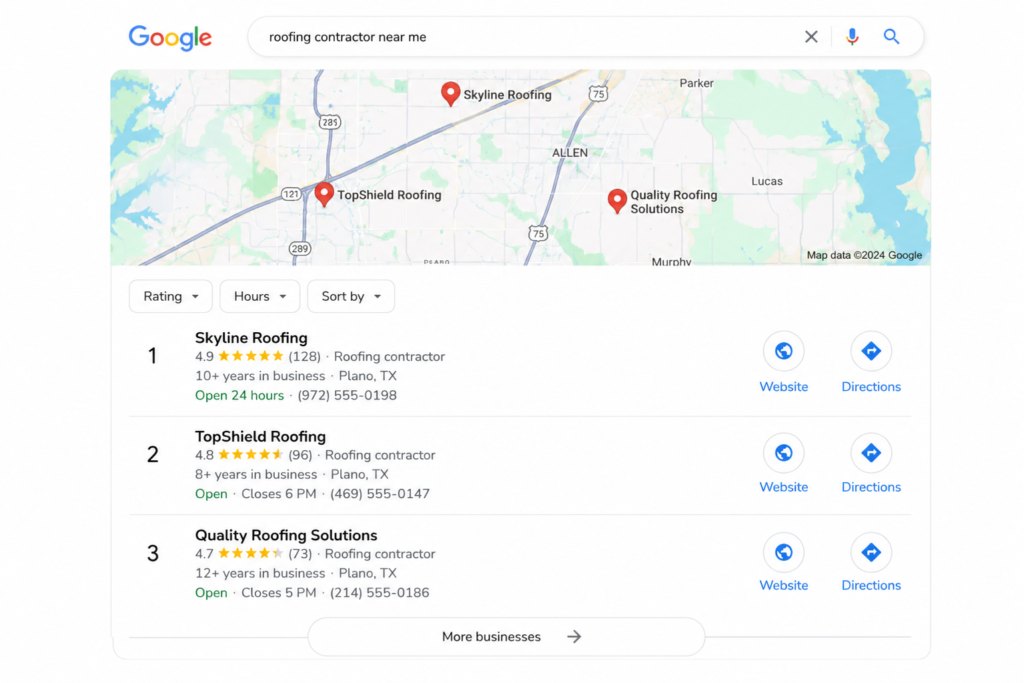
The 3-Second Decision: What Homeowners Actually Evaluate
The Three Factors That Decide Who Gets the Call
Google uses three signals to decide which businesses appear in the Map Pack. Understanding all three is the foundation of everything else in this guide.
| Factor | What It Means | Your Control |
|---|---|---|
| Relevance | How well your Google Business Profile matches the user’s search query | High: Optimize your primary category, services, business description, products, photos, and publish regular posts. |
| Distance | How close your business is to the searcher’s location | Limited: Your physical location cannot be changed for rankings, but creating location-specific service pages and serving nearby areas can improve visibility for broader local searches. |
| Prominence | How well-known, trusted, and authoritative your business appears online | High: Earn more reviews, build consistent local citations, attract quality backlinks, keep your profile active, and increase brand mentions across the web. |
Distance is the one factor you cannot change by moving your office. But proximity only accounts for roughly 55% of ranking decisions. That means a business two miles further away can and regularly does outrank you if their relevance and prominence signals are stronger.
That is good news. It means the ranking is not fixed. It is earned.
Fix Your GBP Category: The Highest-Impact Change You Can Make
Your primary category is the single most powerful field in your Google Business Profile. A survey of local SEO experts by Whitespark consistently ranks category selection as the number one Local Pack ranking factor.
Most home service businesses get this wrong. They select “General Contractor” or “Home Improvement,” categories so broad that Google cannot determine what you actually do. The result is that you rank for nothing specific.
How to Choose the Right Primary Category
Open your Google Business Profile. Go to Edit Profile → Business category. Search for your exact trade. Use the most specific category available.
| Trade | Wrong Category | Right Category |
|---|---|---|
| Roofer | General Contractor | Roofing Contractor |
| Flooring | Home Improvement | Flooring Contractor |
| Remodeler | Construction Company | Remodeling Contractor |
| Cleaner | Cleaning Service | House Cleaning Service |
| Plumber | Home Services | Plumber |
| Electrician | Contractor | Electrician |
| Painter | General Contractor | Painter |
| HVAC | Home Services | HVAC Contractor |
After fixing your primary category, add up to nine secondary categories. Each secondary category is an additional keyword cluster you can rank for. A roofing contractor can add Roof Repair Service, Storm Damage Restoration, Metal Roofing Contractor, Gutter Service, and Emergency Roof Repair as secondary categories.
QUICK WIN
The average time to first Map Pack movement after a category fix: 18 to 24 days.
This is the fastest-returning change in local SEO. It costs nothing and takes 20 minutes.
Do it before anything else on this list.
Build a Review System That Works Every Month
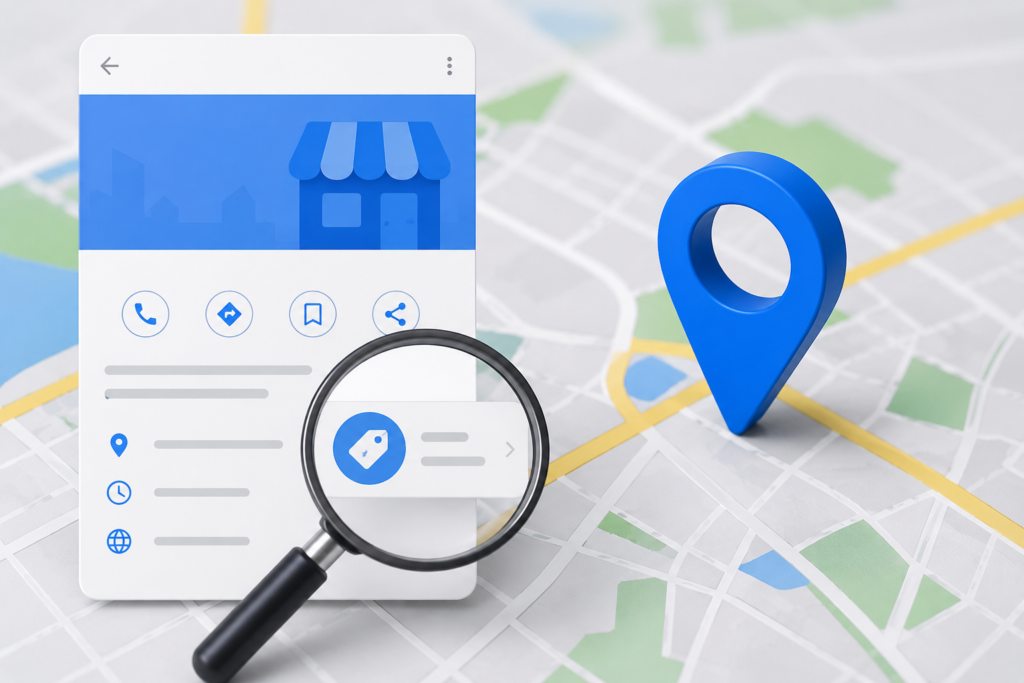
Reviews are no longer just social proof for humans. Google’s algorithm reads, processes, and weights them as a ranking signal. And the signal has changed significantly.
Review recency is now the number one individual ranking factor, having risen from number twenty in 2023 according to BrightLocal’s annual ranking factors survey. A business with five hundred old reviews now regularly ranks below a competitor with fifty recent ones, if ten of those fifty came in the last thirty days.
What Review Recency Decay Means for Your Business
Google applies a temporal decay function to review weight. Reviews older than 180 days contribute only 10 to 20 percent of their original ranking value. Reviews under 30 days carry full weight.
| Review Age | Ranking Weight | Action Required |
|---|---|---|
| Under 30 days | 100%: Full weight | Prioritise collecting these every month |
| 30 to 180 days | Progressive decline | Maintain consistent velocity to offset decay |
| Over 180 days | 10 to 20% of original weight | Cannot recover these. Focus forward. |
How to Build a Review System That Generates 8 to 12 Reviews Per Month
Text every customer within 48 hours of job completion. Response rate drops by 60% after 48 hours.
Send a direct GBP review link, not a link to your homepage. The fewer clicks between request and review, the higher the completion rate.
Ask customers to mention the specific service and city in their review. “Fixed our roof in [city] after the storm” tells Google what you do and where. “Great service” tells Google nothing useful.
Respond to every review within 24 hours. Your response is a content field that Google reads for keyword relevance. Include your service and location naturally: “Thank you for trusting us with your roof repair in [city].”
Aim for 150 or more total reviews. Below 150, AI platforms including ChatGPT and Perplexity rarely surface your business in recommendation responses.
What Is a Growth System for a Home Service Business?
A growth system for a home service business is the combination of SEO, conversion copy, paid advertising, and personal brand built and maintained as one connected structure rather than four separate services. Each pillar reinforces the others: SEO brings the right traffic to pages that convert, copy carries consistent brand trust, brand wins the comparison moment, and ads accelerate what is already proven to work.
Complete Your GBP. Every Incomplete Field Costs You Calls
Google surfaces businesses it trusts. An incomplete profile is a trust signal in the wrong direction. Before any advanced optimisation, make sure these foundations are in place.
NAP Consistency
Your Name, Address, and Phone number must be identical across every online directory. Not similar. Identical. “Smith Roofing LLC” and “Smith Roofing” are different entities to Google’s algorithm. A single inconsistency across Yelp, BBB, Angi, or any other directory weakens your prominence score.
Services Section
Fill the Services section with specific service names, not generic labels. “Roofing” is not a service. “Asphalt Shingle Replacement,” “Emergency Roof Repair,” and “Storm Damage Restoration” are services. Specific service names match specific search queries, and matching search queries is what relevance means to Google.
GBP Description
Write a 750-character business description that mentions your primary service, your service area, and one or two specific details that differentiate you. Mention your city name naturally. Avoid generic phrases like “we are passionate about” and “providing quality service.” They add no relevance signal.
Hours and Attributes
If you offer emergency services, enable the 24/7 hours attribute. A homeowner searching “emergency roof repair” at midnight will not call a business whose GBP shows “Closed.” Google knows whether you appear available and factors it into emergency search rankings.
Activate Your GBP Weekly. Dormant Profiles Rank Poorly
Google rewards profiles that show consistent activity. A profile that was set up two years ago and never touched since sends a signal of low engagement, and low-engagement businesses rank lower.
GBP Posts
Publish one post per week minimum. Each post should include your service keyword, your city name, a real job photo, and a call to action. Posts expire after seven days, so weekly posting maintains a constant active signal. Treat each post like a short blog entry, not a social media caption.
Photos
Profiles with 100 or more photos generate 520% more calls than profiles with fewer than 10, based on Google’s own research. Upload three new photos per week. Before uploading, rename each file descriptively. “roofing-contractor-dallas-storm-damage-repair.jpg” gives Google a location and service signal that “IMG_4832.jpg” does not.
Q and A Section
The Q and A section is one of the most overlooked content fields in Google Business Profile. You can ask and answer your own questions. Write five to eight questions that real customers ask before hiring you. Answer each one in two to three sentences, including your service and city naturally. Google reads these answers for relevance signals and sometimes surfaces them in AI Overview responses.
Frequently Asked Questions
How long does it take to get more calls from Google Maps after optimising?
Does my website matter for Google Maps rankings?
Yes. On-page signals account for 19% of Local Pack rankings and 24% of AI search visibility. Your website and your GBP work as a system. The GBP gets you into the Map Pack. Your website determines whether you appear in AI Overviews and LLM recommendations. A home service business that optimises both consistently outperforms one that focuses on only one.
How many reviews do I need to rank on Google Maps?
There is no fixed number, but 40 or more recent reviews is the threshold where most home service businesses start seeing consistent Map Pack presence in moderately competitive markets. For AI platform recommendations from ChatGPT and Perplexity, 150 or more is the practical threshold based on 2026 visibility data. What matters more than total count is review velocity. Two or more new reviews per week outperforms a static count every time.
What is the difference between Google Maps ranking and AI Overview visibility?
Can I rank on Google Maps in multiple cities without opening new offices?
What should I do first if my home service website is getting traffic but no calls?
Fix your GBP category first. Then check your mobile page speed. If your site loads in over 2.5 seconds on mobile, you are losing calls before visitors make a decision. Then look at what a visitor sees above the fold on your service page. Is there a visible phone number, a specific headline, and at least one trust signal before they scroll? Those three things, category, speed, and above-the-fold trust, account for the majority of conversion failures in home service websites that rank but do not generate calls.
Recent Post



Quick Links:
Contact Details:
- Email: : me@okashasammer.com
- Phone: +92-3335232846