Okasha
Sammer
The Complete Growth System for Home Service Businesses: SEO, Copy, Ads & Brand
Jump To
If you have read other posts on this blog, you have noticed a pattern. Every one points to the same idea: SEO, conversion copy, paid ads, and personal brand are not separate services — they are one system, and most home service businesses work on them as if they are not. This post is the explanation of that system. Everything else connects back to this.
If you read nothing else here, read this: these four pillars, built together, compound into something no single channel can produce alone — a business that gets chosen, not just found.
Here is exactly how that works, why most businesses plateau without realising why, and how to build the system properly — whether you are starting from zero or already have pieces in place.
Why Do Home Service Businesses Plateau Despite Doing Everything Right?
Home service businesses plateau because growth channels, SEO, ads, copy, and brand, are typically built by different people, at different times, with no shared strategy. Each channel can perform well individually while the business stays flat because no single channel can compensate for weaknesses in the others.
The plateau is not a channel problem. It is a coordination problem.
A business owner looks at their marketing and sees: SEO is working. Ads are running. The website looks professional. Reviews are decent. By every individual measure, things look fine. And yet, revenue has been flat for the better part of a year.
The reason is that each channel was built and evaluated in isolation. Nobody measured the thing that actually matters: how all of these work together to turn a stranger into a booked job.
The Four Pillars
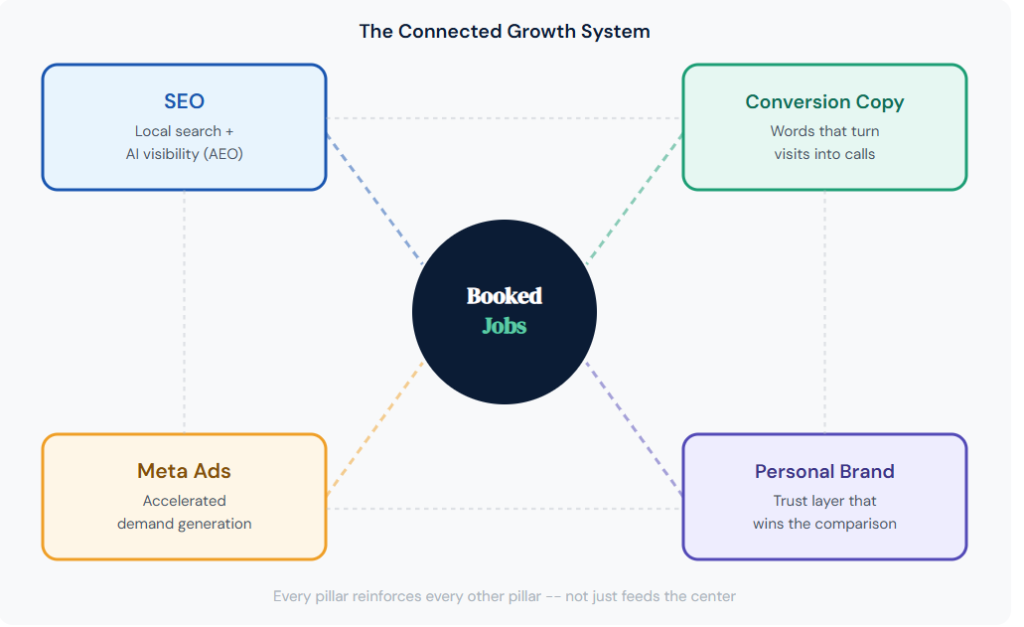
Every home service business that grows online is running these four pillars. The businesses that plateau run them disconnected. The businesses that compound run them as one system.
SEO : Local Search & AI Visibility
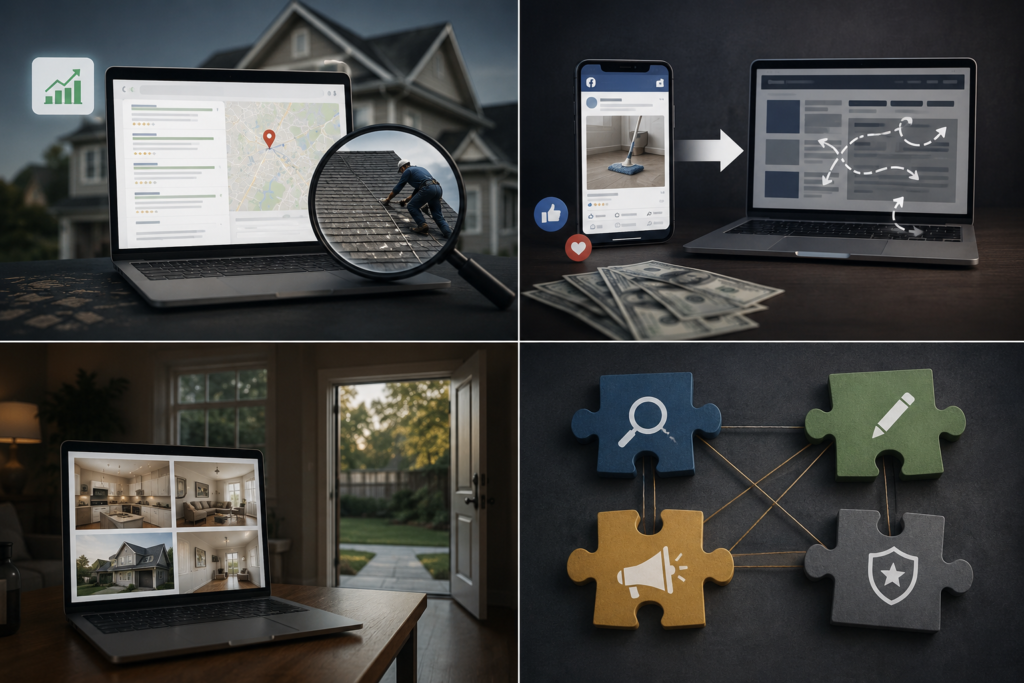
SEO helps your business get found on Google, the Local Pack, and AI tools like ChatGPT and Perplexity when people search for your services. But rankings alone don't generate revenue. Without strong conversion copy, even a #1 ranking can bring traffic that leaves without calling or booking.
Conversion Copy : The Words That Close
Conversion copy turns website visitors into leads through clear messaging, trust signals, compelling offers, and strong calls to action. But without SEO, nobody finds the page, and without a trusted brand, even great copy struggles to convince people to choose your business.
Meta Ads : Accelerated Demand
Ads put your business in front of potential customers before they actively search, helping you grow beyond what SEO alone can achieve. But without a high-converting landing page, ad clicks become wasted budget because visitors leave without taking action.
Personal Brand : The Trust Layer
Brand builds the trust and recognition that makes homeowners choose your business over competitors. But without visibility, people never discover you, and without strong conversion copy, that trust doesn't turn into leads or booked jobs.
Why Each Pillar Fails Without the Others Real Examples
Example 1: Strong SEO, Weak Copy
A roofing business ranked #1 for “roof repair [city].” Organic traffic: over 400 visits per month. Conversion rate: under 1%. The page had a generic headline, no trust signals above the fold, and a “Contact Us” form as the only CTA. SEO did its job perfectly. But position one with a 1% conversion rate produced fewer leads than position four with a 6% conversion rate. That was exactly what was happening with their closest competitor.
Example 2: Strong Ads, Broken Funnel
A cleaning business was spending $1,200/month on Meta ads and generating only 4–6 leads at $240 per lead. The ad had a 1.8% click-through rate, which was genuinely good. But it sent traffic to a homepage with seven navigation links and three competing CTAs. After building one dedicated landing page with message-matched copy, using the same ad and the same budget, the business generated 28 leads at $43 per lead. The ad was never the problem. The missing connection between ads and copy was. Read the full case study here.
Example 3: Good Brand, No Visibility
A remodeling business had excellent brand fundamentals, including an owner story, real before-and-after photos, specific numbers, and authentic reviews. All of it was on their website. The problem was almost no organic traffic and no ads. All of that trust-building work existed on a page nobody was visiting. Brand without visibility is a beautifully designed room with no door.
Example 4: Everything Fine, Nothing Connected
A flooring business had decent SEO, reasonable copy, occasional ads, and a basic brand presence. Individually, nothing was broken. But nothing was connected either. The same generic pages received both SEO traffic and ad traffic. Brand elements existed but were not surfaced at the moments that mattered. Revenue had been flat for fourteen months despite steady effort across all four areas.
What a Connected System Looks Like in Practice
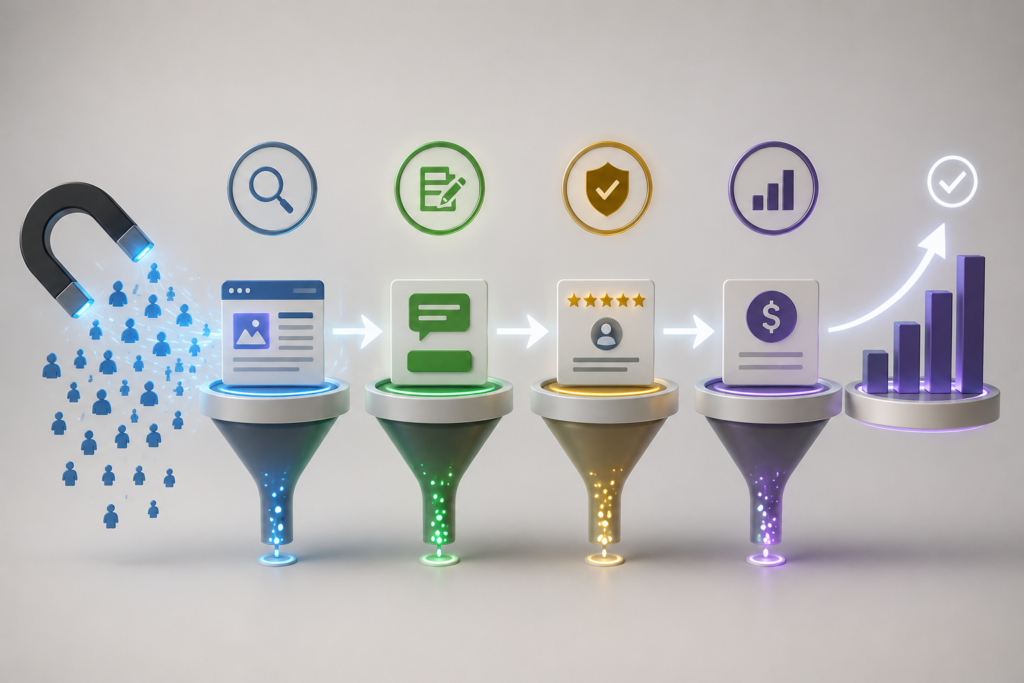
In a disconnected system, improving one pillar by 20% might improve overall results by 2-5%, because the other three pillars cap the impact. In a connected system, improving one pillar by 20% can improve overall results by 15-20%, because the gains flow through every other pillar. This is the entire difference between linear effort and compounding growth
The Diagnostic Framework: How to Find Your Weakest Link
| Question | If the Answer Is Yes | Weakest Link |
|---|---|---|
| Are you getting traffic at all? | Your website gets very few visitors. | Visibility (SEO) or Demand Generation (Ads). Nothing else matters until people are arriving. |
| Of those arriving, how many take action? | Traffic exists, but conversion is very low (under 2–3%). | Conversion Copy. The page is not doing its job of turning visitors into leads. |
| Of those who engage, how many become customers? | Lead conversion is reasonable, but lead-to-customer conversion is low. | Brand Trust. You’re losing prospects during the comparison stage. |
| Is your cost to acquire a customer sustainable? | Customer acquisition costs are too high. | A combination of weak conversion and weak brand differentiation is keeping your cost per lead artificially high. |
What Is a Growth System for a Home Service Business?
A growth system for a home service business is the combination of SEO, conversion copy, paid advertising, and personal brand built and maintained as one connected structure rather than four separate services. Each pillar reinforces the others: SEO brings the right traffic to pages that convert, copy carries consistent brand trust, brand wins the comparison moment, and ads accelerate what is already proven to work.
What Should I Fix First in My Home Service Marketing?
Start with conversion copy on your single highest-traffic page — this has the fastest, most visible impact and is required groundwork for everything else. Then address brand trust elements site-wide. Then invest in SEO and AEO structure. Then use paid ads to accelerate the system you have built.
Fixing channels in any other order, especially starting with ads or SEO before conversion and brand are addressed, typically wastes the largest portion of marketing budget.
This Is Why I Built My Business This Way
Six years ago, I started as an SEO specialist. I got good at rankings. And I kept running into the same wall: clients ranking well, traffic increasing, revenue staying flat.
The problem was never the SEO. It was that SEO was the only thing anyone had built. The copy was generic. The brand was invisible. The ads pointed at pages that could not convert. Every channel was capped by the weakest one — and nobody was looking at the whole picture, because no single specialist is hired to look at the whole picture.
That is why I work across all four pillars — not because I wanted to do everything, but because I kept seeing the same businesses hit the same ceiling, for the same reason, regardless of how good any individual piece of their marketing was.

Frequently Asked Questions
What is a growth system for a home service business?
Why do home service businesses plateau despite doing everything right?
What should I fix first in my home service marketing?
Start with conversion copy on your single highest-traffic page. Then address brand trust elements site-wide. Then invest in SEO and AEO structure. Then use paid ads to accelerate the system you have built. Starting with ads or SEO before conversion and brand are addressed typically wastes the largest portion of marketing budget.
How long does it take to see results from a connected growth system?
Do I need to fix all four pillars at once?
Recent Post

Quick Links:
Contact Details:
- Email: : me@okashasammer.com
- Phone: +92-3335232846